

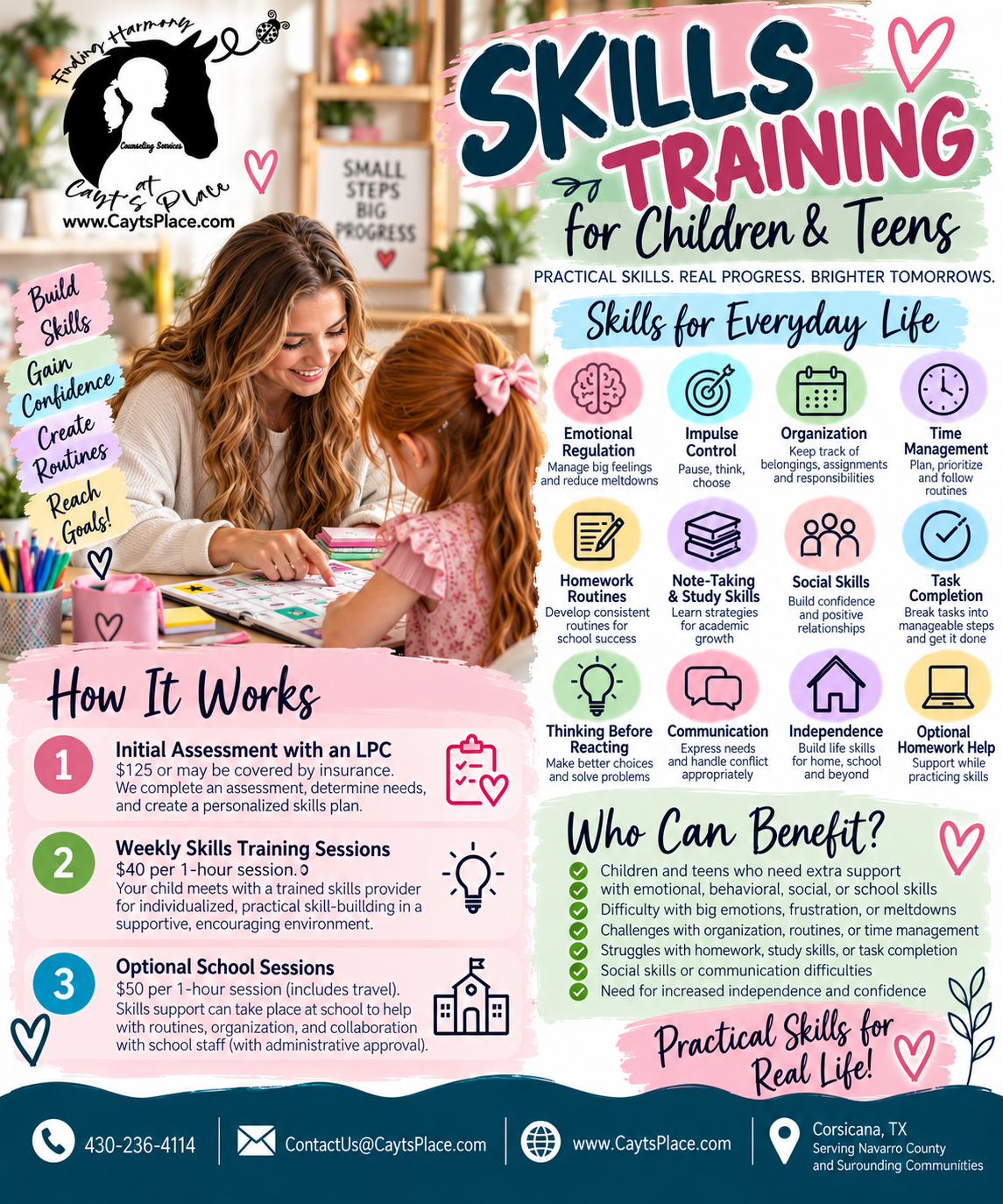
Some children and teens don't necessarily need traditional therapy—they need someone to slow things down, teach a skill, practice it with them, and help them use it in real life.
Finding Harmony at Cayt's Place offers individualized skills training for children and teens who need extra support developing practical emotional, behavioral, social, organizational, or school-related skills. Training is based on each child's individual needs and goals and focuses on skills they can actually use at home, at school, and in everyday situations.
Does My Child Need Therapy—or Skills Training?
Sometimes a child understands what they're supposed to do but struggles with how to actually do it consistently.
Skills training focuses on teaching, practicing, and strengthening specific skills rather than providing psychotherapy. A child may need help learning how to calm down when frustrated, organize schoolwork, complete a routine independently, communicate appropriately, handle conflict with peers, or stop and think before reacting.
When clinical mental health concerns are present, therapy may be recommended in addition to—or before—skills training.
What Can Skills Training Help With?
Emotional & Behavioral Skills
Emotional regulation • managing frustration • coping with big emotions • reducing meltdowns • impulse control • thinking before reacting • problem-solving • following expectations
Organization & Independence
Organization • time management • completing routines • remembering responsibilities • breaking tasks into smaller steps • task initiation • task completion • building independence
School & Homework Skills
Homework routines • note-taking • study skills • keeping track of assignments • planning larger projects • completing and turning in work • preparing for tests • optional homework support
Social & Communication Skills
Social skills • communication • recognizing social cues • handling disagreements • appropriate boundaries • self-advocacy • asking for help • friendship skills • working cooperatively with others
Who Can Benefit From Skills Training?
Skills training may be appropriate for children and teens who need additional support developing practical skills for everyday life. A specific mental health diagnosis is not required simply to benefit from skill-building support.
Some children may struggle primarily at school. Others may have difficulty with routines at home, emotional regulation, social interactions, organization, independence, or following through with responsibilities. The initial assessment helps determine which skills should be targeted and whether skills training is an appropriate service for the child's needs.
1. Initial Assessment with an LPC — $125 or may be covered by insurance
We begin with an assessment to better understand your child's strengths, needs, current challenges, and goals. The LPC then helps determine whether skills training is appropriate and identifies areas to target.
2. Individual Skills Plan
Rather than using the same program for every child, skills are selected based on the child's individual needs. Goals may involve emotional regulation, behavior, organization, social skills, school routines, independence, or a combination of areas.
3. Weekly Skills Training — $40 per one-hour session
Your child or teen works individually with a skills provider to learn and practice specific skills. Sessions are designed to be active, practical, and individualized rather than simply talking about what the child should do differently.
4. Optional School-Based Skills Training — $50 per one-hour session
With school administrative approval, skills training may also take place at school. This can allow skills to be practiced where challenges actually occur and may support collaboration around routines, organization, behavior, social skills, or school responsibilities.
When Therapy Is Needed
Skills training is not psychotherapy and does not replace mental health treatment when clinical therapy is needed.
If concerns arise that indicate a child may benefit from therapy, the skills provider will consult with the supervising LPC. Depending on the child's needs, therapy and skills training may occur concurrently, or skills training may be paused while more immediate therapeutic concerns are addressed.
For Parents & Schools
Skills training can be initiated by families or coordinated with schools when appropriate. School-based services may provide an opportunity to work on skills in the setting where the child is expected to use them.
Schools interested in individualized skills support for students may contact Cayt's Place to discuss available services and program options.
Children don't always need someone to tell them to “try harder.” Sometimes they need a skill broken down, taught differently, practiced repeatedly, and supported until they can use it independently.
Skills training gives children and teens an opportunity to develop practical tools for home, school, relationships, and everyday life.
How It Works
We Don't Just Talk About Skills. We Practice Them.
Knowing what to do and being able to do it consistently are two different things.
Skills sessions may include role-playing real situations, practicing routines, organizing actual school materials, creating schedules or checklists, rehearsing appropriate responses, working through social scenarios, practicing emotional-regulation strategies, completing multi-step activities, or applying strategies to homework and other real-life responsibilities.
The goal is for children and teens to leave with skills they can use—not simply information they heard.
Help Them Build Skills They Can Carry With Them
Finding Harmony at Cayt's Place
Corsicana, Texas • Serving Navarro County and surrounding communities
430-236-4114
ContactUs@CaytsPlace.com
SKILLS TRAINING FOR KIDS & TEENS
Practical support for emotional regulation, behavior, organization, social skills, school routines, and everyday independence.